WHYL wants AI platforms to sell the seconds while the model thinks
The two-founder startup runs a Chrome extension that pays people to watch ads while Claude, ChatGPT or Gemini work. The bigger bet is an SDK that lets any AI product plug into the same marketplace. Co-founder Olalla Levi answered our questions in writing.
 Photo: A person sits facing a wall of app icons. // GaaS News
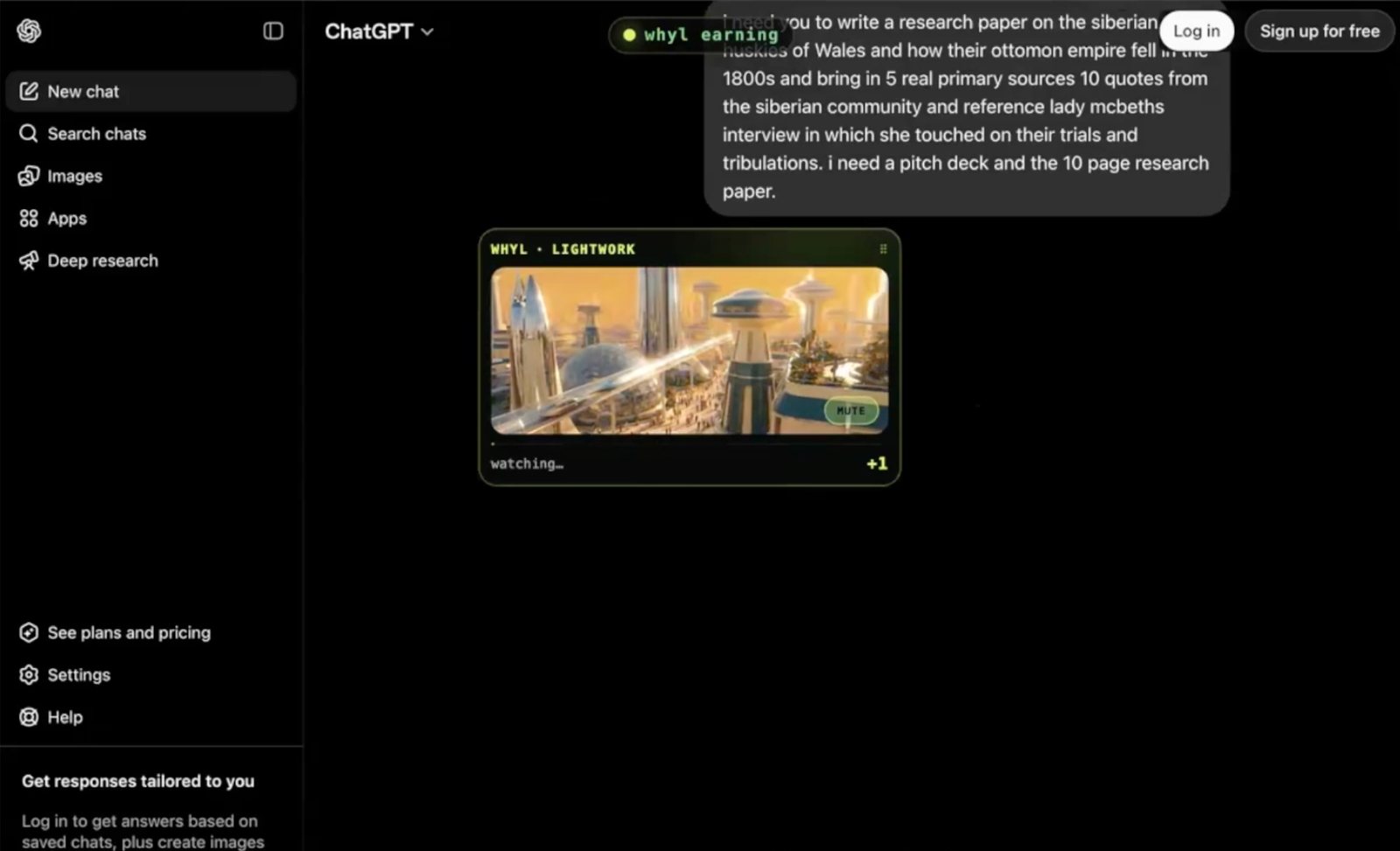
Every AI product has a moment where the user is doing nothing. The prompt is in, the model is working, and a spinner or a shimmering "thinking" label holds the screen. WHYL.ai wants to sell that moment. The startup, founded by two childhood friends, runs a Chrome extension that plays a short sponsored video during those waits on Claude, ChatGPT and Gemini and pays the viewer a cut. It also pitches a drop-in SDK to AI companies so they can run the same ads inside their own products and share in the revenue.
Co-founder Olalla Levi pitched us in late August. Rather than take a demo call, we sent six questions and asked for written answers we could quote. She sent them back this week, and her answers are most useful for what she is careful not to claim.
The incentive problem, in her words
The obvious objection is that every lab is spending heavily to make thinking time shorter, and WHYL is asking them to monetize it. Levi did not dodge it. "We are not asking platforms to preserve or extend latency," she wrote. "If a platform can eliminate a wait, it should. We monetize wait time only when it naturally exists while a model is thinking, searching, coding, generating, or executing."
Her bet is that the wait never disappears, it just changes shape. "As AI products take on more complex and multi-step work, we think those wait states will continue to exist in different forms even as individual tasks get faster." That is a defensible read. Single completions keep getting faster, but agent runs that browse, call tools and retry are getting longer, a trend we have tracked in our reporting on agents that run for days. A ten-second wait on a chatbot might vanish. A four-minute wait on a coding agent probably will not.
Two products, two pitches
Levi is careful to separate the consumer play from the B2B play. The extension is the audience builder. "The product gives people a reason to install because they can earn from attention that would otherwise be spent staring at an AI loading state," she wrote. The SDK is where she thinks the company actually lives. Her pitch to platforms is that WHYL has already built the ad infrastructure and the advertiser relationships, "so they do not have to build an ad business from scratch. They can integrate WHYL into wait states that already exist and participate in the revenue we generate."
In practice that makes WHYL closer to an ad network for a slot that does not exist yet than to a consumer app. On who signs first, she expects the small players to move before the labs. "We expect smaller AI products and wrapper apps to be earlier adopters because incremental revenue per user matters more to them and they can usually move faster on integrations. The larger labs are a longer-term opportunity." That matches the margin picture we described in our piece on why cheap tokens do not make cheap agents. A wrapper app paying retail API prices has thin margins and every extra cent per user counts. Anthropic and OpenAI do not need a video ad to fix their unit economics, and they have brand reasons to avoid one.
Are those seconds worth anything?
We put it to her bluntly: advertisers would be buying some of the lowest-intent seconds on the internet. She pushed back on the framing. "The user may not have commercial intent in that instant, but they are already looking at the interface and temporarily have no result to act on yet. It is a bounded attention window inside a workflow they chose to be in." She also noted that WHYL runs full video creative rather than a text line, which is the clearest product difference from the other extensions in this space. More on those below.
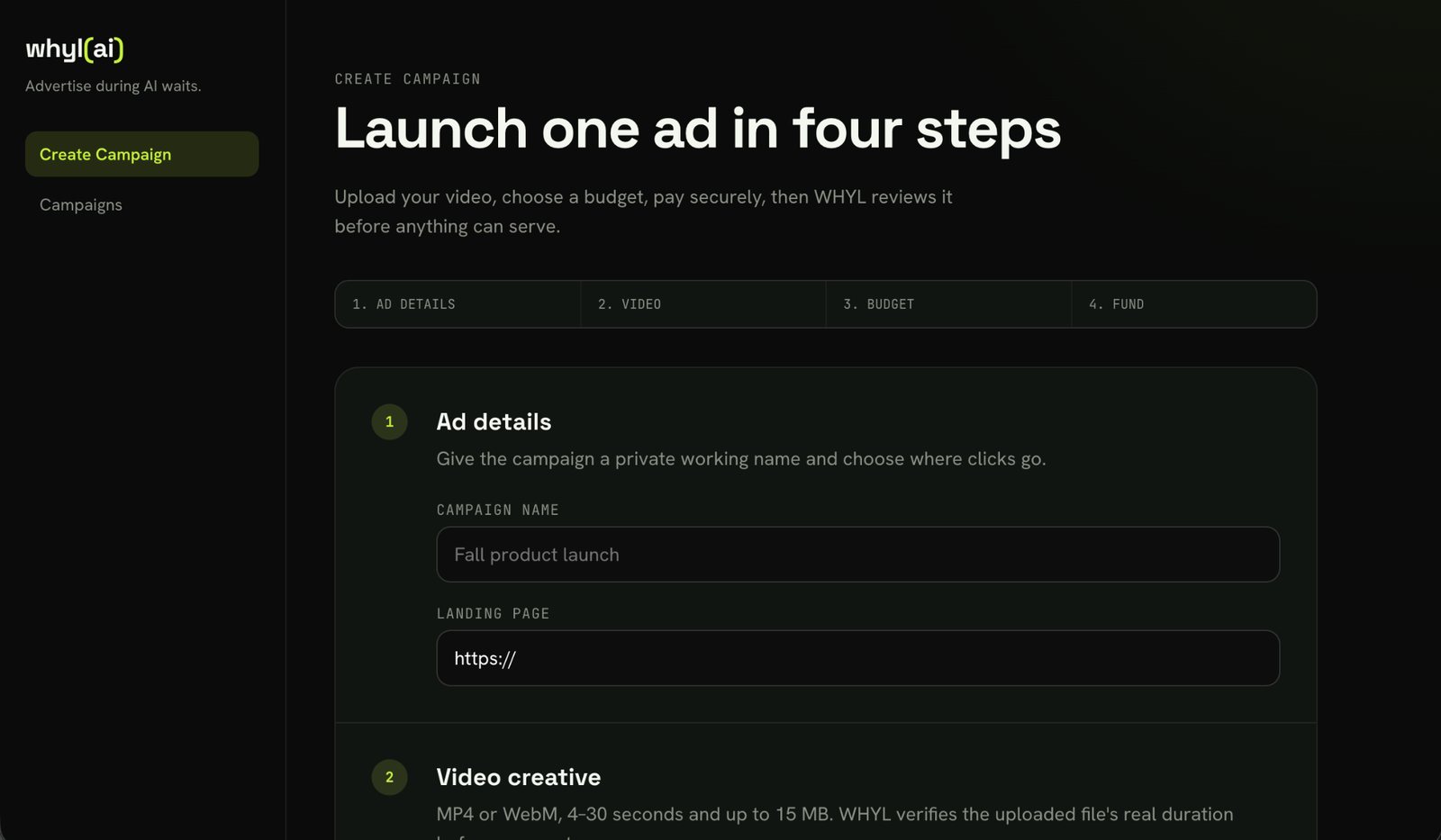
The company's own site lists an average advertiser bid of $2.75 per ad block, the campaign tool accepts video creative of 4 to 30 seconds, and users need a $10 balance before they can withdraw through Stripe. Levi would not put a CPM on the record. "We launched publicly this week, so I do not want to turn a tiny early sample into a fake benchmark." She said the same about user earnings: "I would rather not publish a monthly dollar claim before we have enough stable live usage data to make that number responsible." She also declined to give user or advertiser counts, offering instead to share a number later "that we can stand behind."
That restraint is unusual for a launch-week founder, and it is the responsible answer. It also means the numbers will have to wait. As of Monday the WHYL homepage still described the product as a private beta. Levi says that is stale launch copy and it is being replaced.
A crowded slot
WHYL is not alone in this slot, and the competition arrived fast. A search of the Chrome Web Store on Monday turned up at least three extensions doing a version of the same thing. Chatwait shows a sponsored text line during AI waits, credits users with half the ad revenue and tells heavy users to expect three to eight dollars a month; its listing reports about 2,000 users. Idlen serves developer-focused ads and reports about 1,000 users. EarnPT, which lets users both view and buy campaigns, lists 131. All three figures come from the store listings and none of the products has published audited numbers.
None of those rivals claims a platform SDK, which is where Levi's argument for WHYL rests. If the extension category compresses, and categories like this tend to, the only durable asset is the marketplace behind it and the integrations it can win. She seems to know this. The extension "let us test the consumer behavior and the passive-income proposition without waiting for native platform integrations," she wrote. "From there, the bigger B2B idea became clear: build the ad marketplace and infrastructure once, then let AI products plug into it and share in the economics of wait time they already have."
What we still do not know
The revenue split for an integrated platform is "being structured case by case," so there is no public number. There is no CPM, no earnings figure, no user count and no signed platform. There is also a question Levi did not address and we did not ask well enough: whether a lab would ever let a third party inject video into its interface, given that the same labs now sell premium tiers precisely on the promise of a clean, fast experience. Vendors are already moving toward charging for results, and an ad in the middle of a paid result is a hard sell. The first platform integration, whoever signs it, will tell us more than any of the answers above.
The origin story is a simple one. Levi and her co-founder, Chloe, "kept noticing the same dead space in the product experience: the AI is working, the user is staring at a spinner, and nobody is getting any value from those seconds." Whether those seconds belong to the platform, the advertiser or the person doing the staring is a question the agent economy has not settled yet. WHYL is one of the first companies to try to price it.
Disclosure: WHYL approached GaaS News with this story. No payment or consideration was offered or accepted, and WHYL did not review this article before publication. Quotes are from written answers provided by Olalla Levi on September 6, 2026.